Listed selling prices include the buyer’s premium.
Please contact us if you would like to submit artwork for future auctions.
Artist: Hans Herold
Title: SUNSET IN THE PRAIRIES
Date: 1968
Medium: oil on canvas board
Dimensions: 18 x 24 in. (45.7 x 61 cm)
Notes:
signed and dated lower right; signed and titled verso
LOT: 97
Auction: 2025 June | Hodgins Art Auctions
Artist: Ernest Lindner
Title: BC ROOTS
Date: 1977
Medium: watercolour on paper
Dimensions: 29.5 x 21 in. (74.9 x 53.3 cm)
Notes:
signed and dated lower left; titled on the backing board
LOT: 96
Auction: 2025 June | Hodgins Art Auctions
Artist: Roland Gissing
Title: WHITE HORSE INN
Medium: oil on canvas
Dimensions: 64.5 x 69 in. (163.4 x 175.3 cm)
Notes:
signed lower right; titled on a label verso
LOT: 95
Auction: 2025 June | Hodgins Art Auctions
Artist: Roland Gissing
Title: SHIP INN
Medium: oil on canvas
Dimensions: 64 x 60.5 in. (162.6 x 153.7 cm)
Notes:
signed lower left; titled on a label verso
LOT: 94
Auction: 2025 June | Hodgins Art Auctions
Artist: Alfred Crocker Leighton
Title: THE CHURCH - KENTON - MIDDLESEX
Medium: watercolour on paper
Dimensions: 11.75 x 15.75 in. (29.8 X 40 cm)
Notes:
signed lower left; titled on the matting
LOT: 93
Auction: 2025 June | Hodgins Art Auctions
Artist: Frederic Marlett Bell-Smith
Title: THE TOWER OF LONDON (VIEW FROM THE THAMES)
Medium: watercolour on paper
Dimensions: 7 x 10.5 in. (17.8 x 26.7 cm)
Notes:
signed lower right
Provenance: Masters Gallery, Calgary AB; Loch Gallery, Winnipeg MB
LOT: 91
Auction: 2025 June | Hodgins Art Auctions
Artist: David Brown Milne
Title: SPORTS ARENA (BANCROFT)
Date: 1951
Medium: watercolour on paper
Dimensions: 14.25 x 21.5 in. (36.2 x 54.6 cm)
Notes:
titled and dated verso;
inscribed on the gallery label verso: “Nov 10/69 This W.C. was viewed by David Milne Jr. / He said it was Bancroft / ‘Sports Arena’ written on back in his father’s hand writing” and “Early Feb. 1951 this date is written on the back of the watercolour in Douglas Duncan’s hand writing”
Reference: David Milne Jr. and David P. Silcox, “David B. Milne: Catalogue Raisonné of the Paintings” Volume 2: 1929-1953, cat. no. 503.2
Provenance: Douglas Duncan, Picture Loan Society; Kelly Galleries, Vancouver BC, 1954; Roberts Gallery, Toronto ON, 1969 (label verso); Art Emporium, Vancouver BC, 1977; Masters Gallery, Calgary AB, 1991 (label verso); Estate of Carolyn Tavender, Calgary AB, by descent to family
Exhibited:
Canadian Society of Painters in Watercolour (Toronto ON), 1952; Nickle Arts Museum (Calgary AB), “Sight and Site: Location and the Work of David B. Milne”, August 8 – November 2, 1997 (label verso)
From the late 1940s until he stopped painting in 1952, David Milne focused much of his final artistic effort on the landscapes surrounding Baptiste Lake and Bancroft, Ontario.
Milne had spent much of his life moving from place to place, seeking inspiration from natural surroundings and often solitude in which to paint. In the late 1930s, after a separation from his first wife, Milne and his second wife, Kathleen, moved from Toronto to Uxbridge, Ontario. Their son, David Milne Jr., was born there shortly afterward, and life was busy, though Milne still painted regularly.
By 1947, however, Uxbridge had lost its artistic appeal for Milne, and he was restless and uninspired. In the fall of that year, he embarked on a solo, month-long trip to Baptiste Lake, near the southeastern edge of Algonquin Park, to concentrate on his work. He found a spot near the water where he enjoyed camping, and shortly thereafter, he bought the land from the government for the grand sum of ten dollars.¹
Working independently and without assistance, Milne built himself a log cabin on this land, taking a short break from painting to do so. Once the cabin was complete, he resumed his artistic practice in 1949 and painted there for the remainder of his life. Here, he could live in solitude and focus on his work, with his wife and son joining him periodically.
The small town of Bancroft, Ontario, located approximately 15 kilometers from Baptiste Lake, is the location of the scene depicted in this work “Sports Arena, Bancroft”. Like Milne’s cabin, it was also built in 1948, on the west side of the York River, which runs through the town. The Bancroft Arena was the first covered sports facility in the community, and though it was demolished in 1970, it was still relatively new when Milne painted it in 1951. It served as a community hub for “broomball, figure skating, racing tournaments, and free skating every Sunday.”² As in most Canadian towns, however, hockey remained the main attraction.
Milne’s work at this stage of his life holds a loose and confident elegance, forged over 40 years of painting. As David Silcox wrote: “There was one common aspect to these last paintings. Milne would prepare carefully, map out in his mind the sequence of the work, charge his various brushes with the exact amount of pigment and then, in the manner of the Zen masters, would paint the work in a few minutes.”¹
The entire Milne family moved to Bancroft in 1952, as the artist’s health began to deteriorate. After a series of strokes, David Milne passed away there a year later, in December 1953, at the age of 71.
References:
1. David Silcox, David Milne: An Introduction to His Life and Art, pp. 58-59
2. Orland and Syliva French, “North of 7…and Proud of It!: A parade of Memories from North Hastings,” 2003, p. 185
LOT: 90
Auction: 2025 June | Hodgins Art Auctions
Artist: Bertram Richard Brooker
Title: ABSTRACT TREE TRUNKS AND HOUSE
Medium: oil on board
Dimensions: 11.5 x 15 in. (29.2 x 38.1 cm)
Notes:
Provenance: Heffel (November 2011), from a private collection (Vancouver BC), acquired directly from the artist.
LOT: 89
Auction: 2025 June | Hodgins Art Auctions
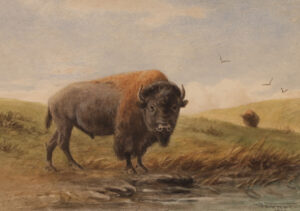
Artist: Frederick Arthur Verner
Title: BUFFALO BULL
Date: 1910
Medium: watercolour on paper
Dimensions: 6.75 x 9.75 in. (17.1 x 24.8 cm)
Notes:
signed and dated lower right; titled verso and inscribed “6493 / 2 / 10106”
Provenance: Alex Fraser Galleries, Vancouver BC; Masters Gallery, Calgary AB (labels verso)
One of the very few painters of his era born in Ontario, Verner is known for his interpretations of Indigenous life in early Canada and nostalgic scenes of bison roaming the West. After attending art school in London as a young man, he spent several years in the British Army before returning to Canada in 1862. In Toronto, Verner began his career as a photograph colourist, exhibiting his paintings, sketches, and colourized photographs to modest acclaim. Notably, he became interested in painting portraits of Indigenous subjects, based on photographs he had taken—an interest that would guide his artistic pursuits for the rest of his life.
Verner began studying and painting the majestic “buffalo” (now more accurately known as the plains bison) early in his career, inspired by the artist Paul Kane and his travels across the Canadian West. His initial depictions were based on works by artists he admired, such as William Jacob Hays and John Mix Stanley. Records of Verner’s own travels westward are inconclusive, and there is only one confirmed account of him journeying to the prairies—his attendance at the 1873 signing of Treaty No. 3 at Lake of the Woods.
“Probably he never saw [a buffalo] outside of captivity,” writes Joan Murray. “Already in 1860 the buffalo had virtually disappeared from the area of present Manitoba.” Verner visited zoos and wild west shows in Canada, New York, and London, where he made sketches that would serve as references for the rest of his career. Despite this, he remained deeply focused on the buffalo as a recurring subject, fascinated by the majesty of the animal.
Verner settled permanently in England in 1880 and made his final trip to Canada in 1909. “Buffalo Bull”, painted in 1910, was almost certainly based on an earlier sketch. These later works are imbued with a quiet, solitary melancholy. Verner had firmly attached himself to the buffalo, and in many ways, his paintings reflect the arc of his own life. In 1910 he was 74, and a new generation of Canadian artists—fresh from the Paris academies—was beginning to emerge. His wife had died in 1906, and there is no record that they had children. The buffalo, too, had dwindled nearly to extinction. Here, the bull and its distant companion gaze back at us with a calm, haunting solitude.
Reference:
Joan Murray, “The Last Buffalo: The Work of Frederick Arthur Verner, Painter of the Northwest”, 1984, pp. 54, 66,103
LOT: 88
Auction: 2025 June | Hodgins Art Auctions
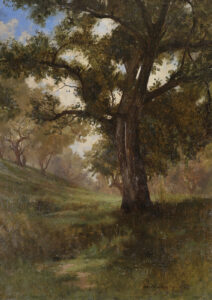
Artist: Gutzon Borglum
Title: CALIFORNIA OAK TREES
Date: 1896
Medium: oil on canvas
Dimensions: 35 x 25 in. (88.9 x 63.5 cm)
Notes:
signed and dated lower right; titled on a brass plaque
Provenance: A frame mounted plaque reads “PRESENTED TO / THE RANCHMENS CLUB / BY / VARIAN S. GREEN / IN MEMORY OF / F.J. GREEN / 1965”. Full additional details of provenance to be provided to the successful purchaser.
Note: Gutzon Borglum was an American artist, who is best known for his colossal sculpture of the faces of four US presidents on Mount Rushmore in South Dakota.
LOT: 87
Auction: 2025 June | Hodgins Art Auctions