
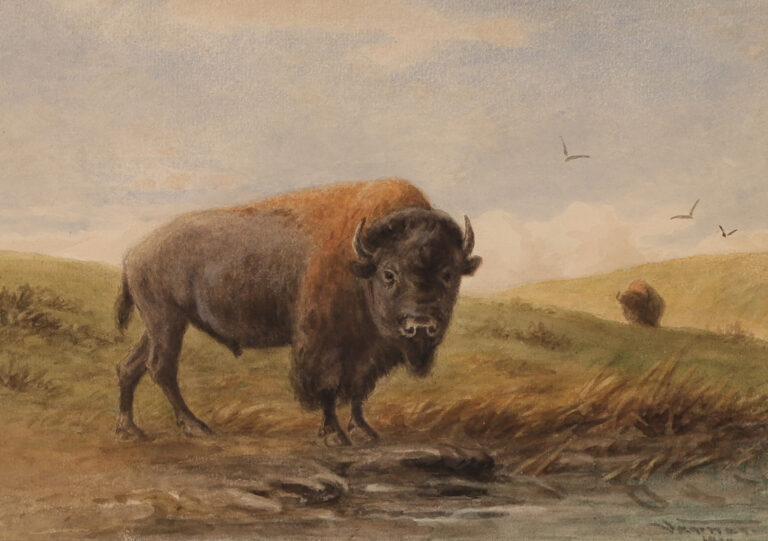
BUFFALO BULL
watercolour on paper
6.75 x 9.75 in. (17.1 x 24.8 cm)
Price Realized:
$ 4800.00 CAD.
INCLUDES BUYER’S PREMIUM
Notes:
signed and dated lower right; titled verso and inscribed “6493 / 2 / 10106”
Provenance: Alex Fraser Galleries, Vancouver BC; Masters Gallery, Calgary AB (labels verso)
One of the very few painters of his era born in Ontario, Verner is known for his interpretations of Indigenous life in early Canada and nostalgic scenes of bison roaming the West. After attending art school in London as a young man, he spent several years in the British Army before returning to Canada in 1862. In Toronto, Verner began his career as a photograph colourist, exhibiting his paintings, sketches, and colourized photographs to modest acclaim. Notably, he became interested in painting portraits of Indigenous subjects, based on photographs he had taken—an interest that would guide his artistic pursuits for the rest of his life.
Verner began studying and painting the majestic “buffalo” (now more accurately known as the plains bison) early in his career, inspired by the artist Paul Kane and his travels across the Canadian West. His initial depictions were based on works by artists he admired, such as William Jacob Hays and John Mix Stanley. Records of Verner’s own travels westward are inconclusive, and there is only one confirmed account of him journeying to the prairies—his attendance at the 1873 signing of Treaty No. 3 at Lake of the Woods.
“Probably he never saw [a buffalo] outside of captivity,” writes Joan Murray. “Already in 1860 the buffalo had virtually disappeared from the area of present Manitoba.” Verner visited zoos and wild west shows in Canada, New York, and London, where he made sketches that would serve as references for the rest of his career. Despite this, he remained deeply focused on the buffalo as a recurring subject, fascinated by the majesty of the animal.
Verner settled permanently in England in 1880 and made his final trip to Canada in 1909. “Buffalo Bull”, painted in 1910, was almost certainly based on an earlier sketch. These later works are imbued with a quiet, solitary melancholy. Verner had firmly attached himself to the buffalo, and in many ways, his paintings reflect the arc of his own life. In 1910 he was 74, and a new generation of Canadian artists—fresh from the Paris academies—was beginning to emerge. His wife had died in 1906, and there is no record that they had children. The buffalo, too, had dwindled nearly to extinction. Here, the bull and its distant companion gaze back at us with a calm, haunting solitude.
Reference:
Joan Murray, “The Last Buffalo: The Work of Frederick Arthur Verner, Painter of the Northwest”, 1984, pp. 54, 66,103