
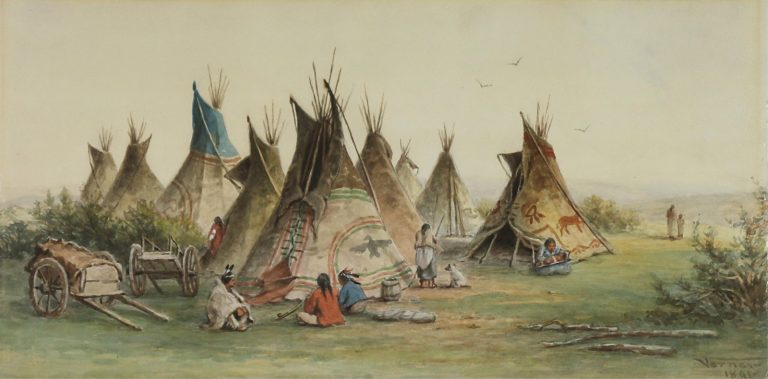
INDIAN ENCAMPMENT
watercolour on paper
12 x 24 in. (30.5 x 61 cm)
Price Realized:
$ 35100.00 CAD.
INCLUDES BUYER’S PREMIUM
Notes:
signed & dated; titled on accompanying gallery label and receipt
Provenance: Gainsborough Galleries, Calgary; Estate of Eric Connelly, Calgary
Reference: “The Last Buffalo: The Story of Frederick Arthur Verner, Painter of the Canadian West”; (Joan Murray, Pagurian Press, 1984)
As a young man of 16, demonstrating early artistic talent, Verner first exhibited at the Upper Canada Provincial Art Exhibition. It was here that he met renowned artist Paul Kane, whose paintings of Canada’s indigenous peoples he greatly admired. After leaving for England, where he studied and served with the British Army, Verner returned to Canada to commence an artistic career as a photographer and colourist. He continued to sketch and draw inspiration from native subject matter, but realized that he needed to study his subjects from real life.
In 1867 Verner sketched teepees at the Provincial Exhibition in Toronto (Sioux Tepees, pg. 43) and would use these in many later works. According to some accounts Verner likely travelled west, over the old trade route, as early as 1862 “travelling by Red River cart, horseback, canoe, and by foot” (p. 53). Though his first recorded sketching trip was in 1873, at which time he produced and dated five sketches critical to his later work (pp. 58-60). Verner used these and other early sketches for the composition of his later paintings – combining scenes and details from various studies in his finished works – thus creating the romanticized and iconic scenes for which he has come to be known, and transporting the viewer to a lost era.
Collections: Sioux Encampment, Red River; 1873 / An Encampment of Cree Hunters; 1889 (Glenbow Museum); Sioux Teepees; 1873 / Lake of the Woods; 1873 / Tents and Red River Carts; 1873 (National Gallery of Canada)