
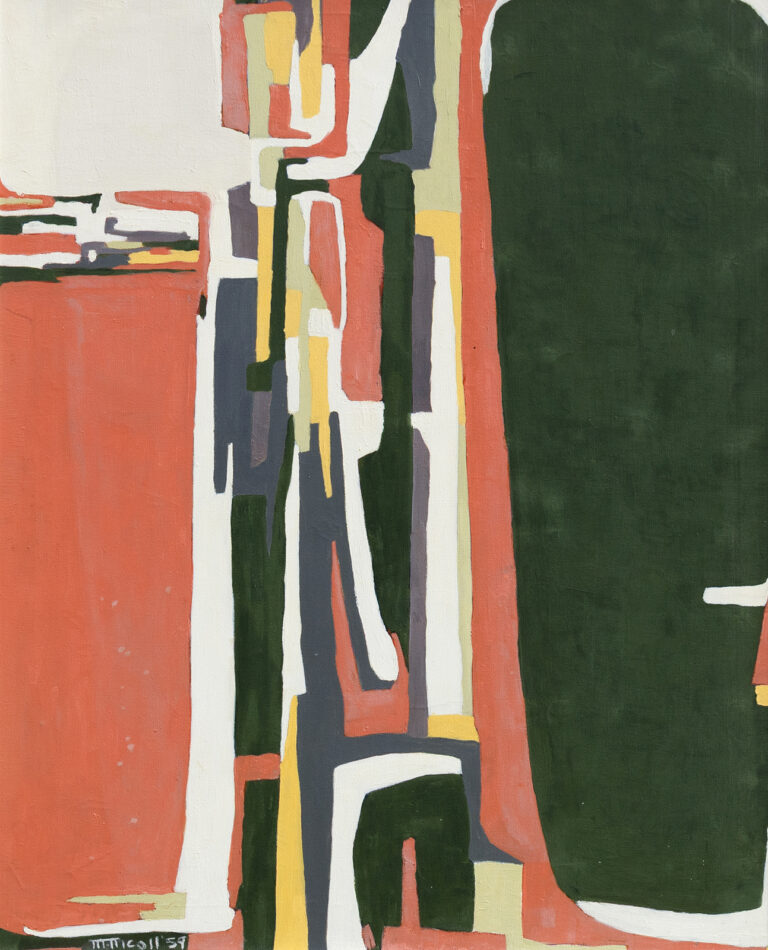
SELF PORTRAIT
oil on canvas
30.25 x 24.25 in. (76.8 x 61.6 cm)
Price Realized:
$ 72000.00 CAD.
INCLUDES BUYER’S PREMIUM
Notes:
signed and dated lower left; signed, titled and dated “Dec 10 -’58” verso; inscribed “W. Barnet / Spring ’59 / Class Show” and “Can. Customs/ Tariff Item / NO. 695A” verso
Provenance: Estate of Carolyn Tavender, Calgary AB, by descent to family
Exhibited: The Glenbow Museum, Calgary AB, “Marion Nicoll: Art and Influences”, April 5, 1986 – June 9, 1986; and toured to the Edmonton Art Gallery, Edmonton AB, August 23 – October 26, 1986
Illustrated on page 28 of the exhibition catalogue for “Marion Nicoll: Art and Influences”. A copy of the exhibition catalogue is included with this painting.
Illustrated on page 65 of “Marion Nicoll: Life & Work” (Catharine Mastin, 2022)
To fully contextualize Marion Nicoll’s vibrant Self Portrait, painted in New York City in 1959, it is helpful to understand the artistic transformation she was undergoing at the time. While today we recognize Nicoll as a powerful force in Canadian modernism, her journey toward pure abstraction began only two years earlier, in 1957, when she was 46 years old. That year, along with several colleagues from the Provincial Institute of Technology’s art department, Nicoll attended the renowned Emma Lake workshop, led by American abstractionist Will Barnet. Until this point, Nicoll’s experience in the fine art world had been somewhat limited by gendered barriers, despite her strong drive to paint. She was a prolific artist and had recently begun experimenting with automatic painting. The Calgary art scene at the time, however, was thoroughly traditional. Despite being classically trained in the fine arts, Nicoll was the only female instructor at the Tech for most of her career. She had been hired to lead the School of Crafts, a role in which she excelled, but she was first and foremost, a painter. Having taught since 1933, by 1957 Nicoll was feeling uninspired, yet hopeful for a new spark.
Barnet’s workshop at Emma Lake changed everything. Initially intended to focus on printmaking, the course pivoted to watercolour when supplies failed to arrive. Barnet emphasized the importance of pure form and colour, teaching students how to distill what they saw – abstracting the visual world into something more essential. Nicoll responded almost immediately. After the workshop, inspired by her progress, she made the pivotal decision to follow Barnet to New York City to continue her studies at the Art Students League of New York. During the 1957–58 academic year, she arranged a self-financed leave from the Tech and, together with her husband, Jim Nicoll, arrived in New York in the late summer of 1958.
If Nicoll had flourished at Emma Lake, she thrived in New York. Far from the conservative Alberta art scene and the constraints of her teaching position, she was able to devote herself entirely to her work. From September 1958 to April 1959, she maintained rigorous studio hours and, alongside Jim, immersed herself in everything New York had to offer. The Barnets introduced the Nicolls to central figures in the art world; they attended exhibitions, theatre, opera, and ballet – fully engaging in the city’s cultural life, which fueled her creativity. “Painting is my whole obsession,” she wrote to her Calgarian friend Trudy Carlyle in December 1958. “Everything else takes place around it….I teem with things to say in paint. [And] Trudi, I’m making great big strides – you wouldn’t recognize the work I’m doing.”1
With this journey from 1957 to 1959 in mind, Nicoll’s Self Portrait can be seen in a new light. Likely begun in the winter of 1958 and completed in the spring of 1959, the painting is anchored by a central cluster of fragmented, angular forms – deep olive greens stacked with wheaty yellows and vermillion reds – flanked by large expanses of colour. In under two years, Nicoll’s trajectory had transformed: she had expanded her horizons, and both her life and artistic practice were irrevocably changed. In “Self Portrait”, as she first learned at Emma Lake, she distills herself into pure form and colour – fragmented pieces that fit together yet seem poised to spill out of the frame.
Marion Nicoll would notably return to this self portrait 20 years later in 1979, in an edition of clay prints that were included with Brooks Joyner’s book “Marion Nicoll: RCA”. By then, Nicoll was constrained by her arthritis, no longer able to paint, but an avid printmaker. The similarities are striking, and as Catharine Mastin writes in her biography on Nicoll: “Like many of her prints, [Self Portrait, 1979] was an extension of her painting practice – this one following the oil painting ‘Self Portrait’, which she created in 1959. It was no coincidence that she chose to bookend her practice with these two images to close two decades of her feminist journey.”2
References:
1. Marion Nicoll, letter to Trudy Carlyle, December 26, 1958, Trudy Carlyle Fonds, Glenbow Archives, University of Calgary, CA ACU GBA F0480-S0006-FL0001.
2. Catharine Mastin, Marion Nicoll: Life and Work (Toronto: Art Canada Institute, 2022).