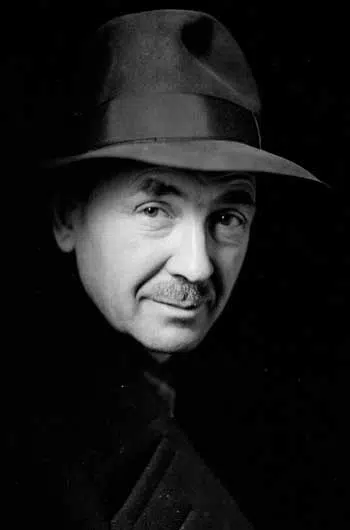
Canadian [1892-1978]
Order of Canada, Royal Canadian Academy of Arts
Descended from French and Russian aristocracy, Nicholas de Grandmaison had a cultured upbringing, studying music, art, history and languages. At 19, he enlisted in the Russian Army and served during World War I, where he became a German prisoner of war.
During his four years of internment, he turned to portraiture as a diversion, painting fellow officers, and even German officers. After the war, he eventually made his way to London, where his courtly manners and charm helped him gain admission to the St. John’s Wood School of Art and to secure painting commissions.
De Grandmaison emigrated to Canada in 1923, listed officially as a “farm worker”, though once arriving in Manitou, Manitoba, it became clear that he had no affinity or desire for farm work. He joined the Art Club of Winnipeg, secured work at a printing/engraving firm, and was soon again seeking commissions – these were often of children, though he would later say that he did not like to paint children “for they have not lived enough or suffered enough to have interesting faces.”
In 1930, on a trip to The Pas, in northern Manitoba, de Grandmaison was first exposed to First Nations people living in a traditional setting . He was immediately captivated and sought out opportunities to draw them. It became his mission in life. He travelled west of Winnipeg and to various Cree communities in Saskatchewan, then to Southern Alberta where he encountered the Blackfoot, Sarcee, Peigan, Stoney, and Blood Tribes.
After a period of living and teaching in Calgary, the de Grandmaisons finally settled in Banff, where Nicholas would set up his home and studio. De Grandmaison held a romantic vision of the Plains Indians as the aristocrats of North America; he felt a strong affinity with them, perhaps as a result of having experienced the destruction of his own culture during the Russian Civil War.
De Grandmaison’s greatest contribution is in the artistic preservation of First Nations people, to which he devoted four decades . Whether drawing a great Chief, an elder, a warrior, or a mother and child, his dignified and emotive portraits capture not only the essence of the individual as a person, but as a member of a proud and ancient people.
Nicholas de Grandmaison’s honours include membership in the Royal Canadian Academy, the Order of Canada, and an honourary degree from the University of Calgary. Yet his greatest tribute came upon his death in 1978, when Nicholas de Grandmaison (Enuk-sapop or Little Plume) was buried on the Peigan Reserve, having been made an Honorary Chief in 1959.
Artist: Nicholas de Grandmaison
Title: UNTITLED (PORTRAIT-INDIAN BRAVE)
Medium: pastel on paper
Dimensions: 19 x 14 in.
Notes:
signed
LOT: 36
Auction: 2006 November | Hodgins Art Auctions
Artist: Nicholas de Grandmaison
Title: UNTITLED; INDIAN PORTRAIT
Medium: pastel on paper
Dimensions: 26 x 20 1/4 in.
Notes:
signed
LOT: 273
Auction: 2006 November | Hodgins Art Auctions
Artist: Nicholas de Grandmaison
Title: SITTING EAGLE - JOHN HUNTER (1874-1970)
Medium: pastel on paper
Dimensions: 24 x 18.5 in. (61 x 47 cm)
Notes:
signed
Note: Sitting Eagle was a noted patriarch of the Chiniki Band of the Stoney Tribe in Morley, Alberta. He was recognized for his business and ranching acumen, and among other tributes, was commemorated by the Calgary Stampede Board in 1951.
Descended from French and Russian aristocracy, Nicholas de Grandmaison had a cultured upbringing, studying music, art, history and languages. At 19, he enlisted in the Russian Army and served during World War I, where he became a German prisoner of war. During his four years of internment, he turned to portraiture as a diversion, painting fellow officers, and even German officers. After the war, he eventually made his way to London, where his courtly manners and charm helped him gain admission to the St. John’s Wood School of Art and to secure painting commissions.
De Grandmaison emigrated to Canada in 1923, listed officially as a “farm worker”, though once arriving in Manitou, Manitoba, it became clear that he had no affinity or desire for farm work. He joined the Art Club of Winnipeg, secured work at a printing/engraving firm, and was soon again seeking commissions – these were often of children, though he would later say that he did not like to paint children “for they have not lived enough or suffered enough to have interesting faces.”
In 1930, on a trip to The Pas, in northern Manitoba, de Grandmaison was first exposed to First Nations people living in a traditional setting . He was immediately captivated and sought out opportunities to draw them. It became his mission in life. He travelled west of Winnipeg and to various Cree communities in Saskatchewan, then to Southern Alberta where he encountered the Blackfoot, Sarcee, Peigan, Stoney, and Blood Tribes. After a period of living and teaching in Calgary, the de Grandmaisons finally settled in Banff, where Nicholas would set up his home and studio. De Grandmaison held a romantic vision of the Plains Indians as the aristocrats of North America; he felt a strong affinity with them, perhaps as a result of having experienced the destruction of his own culture during the Russian Civil War.
De Grandmaison’s greatest contribution is in the artistic preservation of First Nations people, to which he devoted four decades . Whether drawing a great Chief, an elder, a warrior, or a mother and child, his dignified and emotive portraits capture not only the essence of the individual as a person, but as a member of a proud and ancient people.
Nicholas de Grandmaison’s honours include membership in the Royal Canadian Academy, the Order of Canada, and an honourary degree from the University of Calgary. Yet his greatest tribute came upon his death in 1978, when Nicholas de Grandmaison (Enuk-sapop or Little Plume) was buried on the Peigan Reserve, having been made an Honorary Chief in 1959.
LOT: 72
Auction: 2017 May | Hodgins Art Auctions
Artist: Nicholas de Grandmaison
Title: MOTHER AND CHILD
Medium: pastel on paper
Dimensions: 25 x 21 in. (63.5 x 53.3 cm)
Notes:
signed
LOT: 73
Auction: 2017 May | Hodgins Art Auctions
Artist: Nicholas de Grandmaison
Title: UNTITLED PORTRAIT
Medium: oil on canvas
Dimensions: 24 x 18 in. (61 x 45.7 cm)
Notes:
signed lower left
Literature: History in Their Blood: The Indian Portraits of Nicholas de Grandmaison (Hugh A. Dempsey; Douglas & McIntryre Ltd.; 1982); “Drawn from the Past: Nicholas de Grandmaison” (Gordon Snyder; Snyder Fine Arts; 2007)
LOT: 109
Auction: 2022 November | Hodgins Art Auctions
Artist: Nicholas de Grandmaison
Title: WOLF TAIL (APISOH'SOYI), PEIGAN - BROCKET, ALBERTA
Medium: pastel on paper
Dimensions: 16.5 x 11.75 in. (41.9 x 29.8 cm)
Notes:
signed
Provenance: Masters Gallery, Calgary AB (label verso)
Note: Beginning in 1930, during a trip to The Pas, in northern Manitoba, de Grandmaison began what would become his life’s work, the creation of a visual record of members of the Plains First Nations. The portraits of his subjects spanned more than four decades, and de Grandmaison was known to sketch a favourite subject on several occasions. In this case, the artist is recorded to have painted Wolf Tail several times between 1930 and 1960. Wolf Tail (Apisoh’soyi), was a Peigan healer and herbalist, and did for a time work with the Indian Department.
Reference: pp. 50, 51, 104, and 107 “History in Their Blood: The Indian Portraits of Nicholas de Grandmaison” (Dempsey; Douglas & McIntyre Ltd., 1982).
LOT: 36
Auction: 2018 May | Hodgins Art Auctions

Since 1983, Hodgins Art Auctions is your trusted source for buying and selling art by Nicholas de Grandmaison and other important Canadian artists.
We are always accepting consignments of quality Canadian & International art.
At Hodgins you will always be dealing with a knowledgeable partner in the company. We provide responsive and efficient service, transparency, and are committed to your satisfaction.