

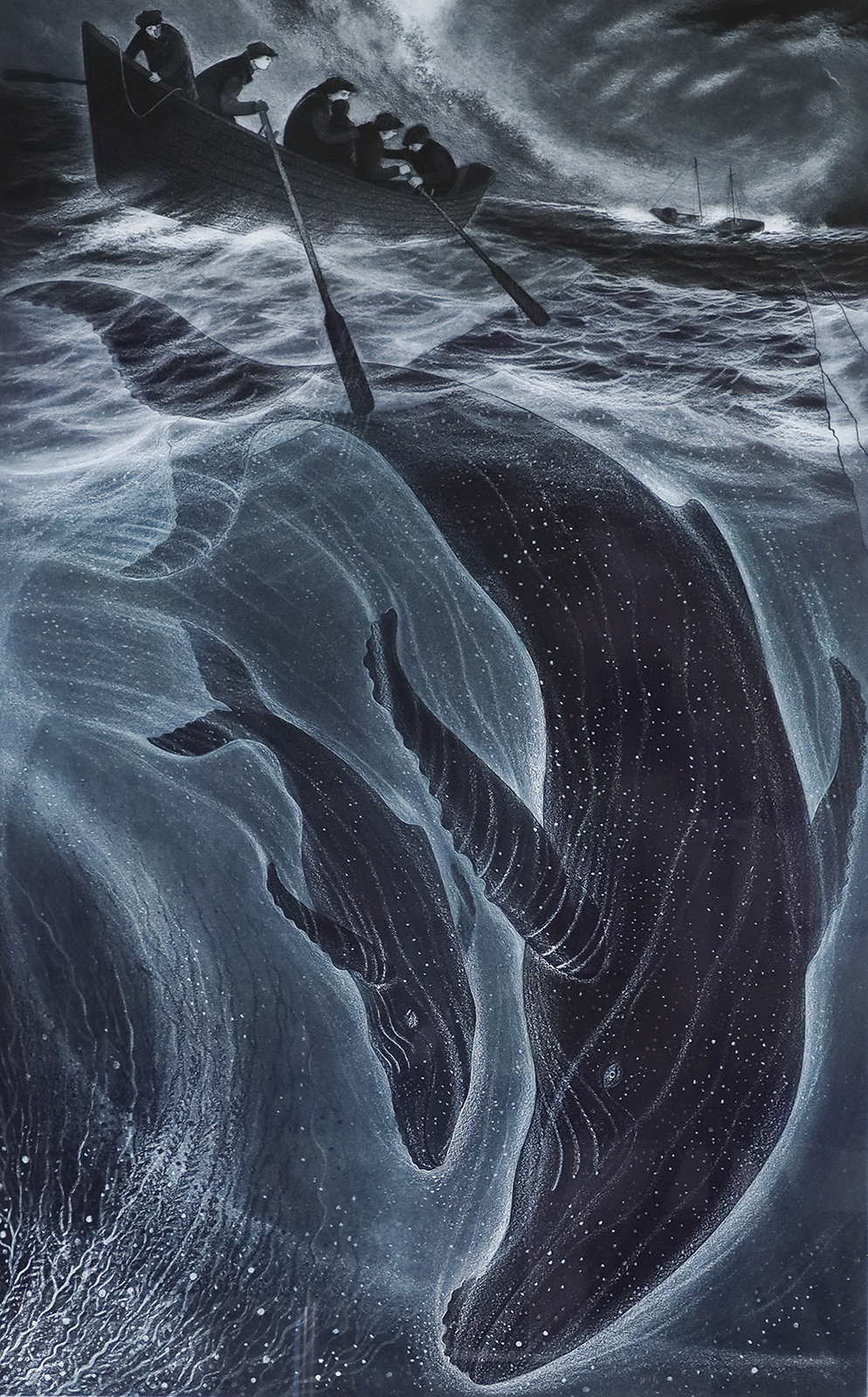
signed, titled, dated and editioned in pencil
Note: This work is illustrated on page 16 of “David Blackwood: Master Printmaker” (William Gough; Firefly Books; 2001); and as plate 61 in “Black Ice: David Blackwood, Prints of Newfoundland (Katharine Lochlan, editor; Douglas & McIntyre/Art Gallery of Ontario; 2011).
David Blackwood’s experiences growing up on the northeast coast of Newfoundland laid the foundations for an important artistic practice that spanned over 50 years. Dubbed the “gothic master” of his home province, the artist’s dramatic visions of life by the sea are an amalgamation of real historical events, legends, dreams, and childhood memories. Born in Wesleyville to a seafaring family, Blackwood’s father and grandfather were ship captains, and so as a child, he spent many summers aboard his father’s schooner, the Flora S. Nickerson.
Blackwood’s scenes of the cold Atlantic unfold dramatically, the treacherous bid to survive on the frigid waters. “It is a landscape both mysterious and starkly simple,” he noted; “… a region of tremendous, even surreal, contrasts of atmosphere, light, and character. Its strange, bleak beauty carries an undercurrent of danger, an undefined threat which seems to lurk just below the surface.”
In The Loss of the Flora S. Nickerson, David Blackwood gives us a glimpse under the waves, where an enormous mother whale, positioned protectively over her calf, glides perilously close to the rowboat above. The intensity of the moment is palpable, and we see a parallel moment of parental protection in the rowboat above, where a child is huddled protectively in the arms of one of the passengers.
“One gets a sense that powers as old as Creation move through this watery dreamscape,” Blackwood observed; “and that the whales who spectacularly breach and sound into its black depths are somehow an embodiment of this sublime power.”
Reference: “The Light Keeper”, Darcy Rhyno, Saltscapes Magazine, November/December 2008, Vol. 9(6), pp. 25-29.
